


Your website is your modern day business card and most influential brand ambassador. However, as search engines continue to evolve into AI-driven answer engines, simply having a website is no longer enough to remain competitive.
With AI now handling around 25% of global queries, and with Google’s AI Overviews dominating the top of search results, the goal of SEO is to now become the primary source for these AI-generated summaries.
To capture high-value traffic, it’s important to transition your SEO efforts from basic keyword placement to a holistic strategy based around authority, technical precision, and user intent. You can see this in practice in our SEO research with Marina Bay Sands.
Here’s how to improve your SEO to help safeguard your website from the noise of the second page.
1. Optimise for AI overviews and GEO (Generative Engine Optimisation)
Search behaviour has shifted from query and click to ask and answer. That’s why it’s important to continue to optimise your search strategy, especially for AI overviews and GEO.
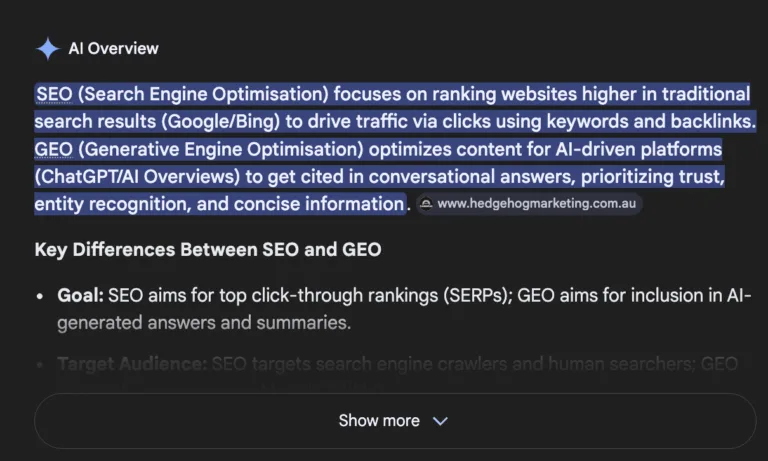
So, how do you do that?
- The strategy: Transition your content into a structured data format to help AI models and search engines instantly identify key entities like services, locations, and credentials from your website. To do this, use clear, definitive headers and concise “what is” or “how to” sections as it allows AI models to easily scan, grab content and credit when cited or mentioned.
- The value: Being cited or mentioned by an AI overview or within an LLM environment helps establish instant industry leadership and builds mental availability before a user even scrolls. It helps keep you relevant and increases your chances of receiving a click-through to your site, within a zero-click environment.
Read our latest article on the difference between SEO and GEO here.
2. Double down on E-E-A-T
We’re now living in an era of mass-produced AI content. Despite this, Google has pivoted their strategy and rewards businesses that provide the optimal human experience.
Why? Because recent studies have found that 88% of customers look for reviews and authentic proof before choosing a service. So, showing off your thought-leadership and authority is your best defence against generic AI competition.
- The strategy: Showcase the work your business has achieved through engaging case studies, utilise unique data (if appropriate) and implement verified author bios with credentials. If you’re developing long form content, remember, don’t just give advice; tell your visitor a story, paint the overarching picture for them and include original photos or videos to help bring it to life.
- The value: High E-E-A-T scores are your best defense against algorithm updates, ensuring your rankings remain stable while thin content sites drop off. By adding each little authority contribution across your site, it goes on to build a deep trust between your business, your website visitors (and the bots). One that makes it hard for competitors to compete against.
3. Master hyperlocal SEO
For service-based businesses, your local visibility is the highest-converting form of SEO. With 46% of all Google searches having local intent and 78% of local mobile searches ending in an offline purchase, your Google Business Profile (GBP) is often more important than your website’s homepage. So, it deserves the same love, attention and optimisation opportunities as your website.
- The strategy: Make sure your GBP is active with weekly updates, geo-tagged images, and a consistent strategy for responding to client reviews. And when it comes to creating long form content, go beyond city level; build out a library of content that’s tailored for specific suburbs or landmarks.
- The value: Dominating the local map pack delivers some of the highest ROIs, turning nearby searchers into immediate customers. This is because focusing on keywords with local intent will place you in front of high-value users, who are closer to converting than those searching for broader, non-specific terms.
4. Technical health importance
User experience is a quantifiable ranking factor and site speed isn’t just a nice to have; it’s a direct ranking factor. As of this year (2026), Interaction to Next Paint (INP) – a metric measuring how fast your page feels once someone starts engaging with it – is the gold standard for technical health.
If your site takes more than 200 milliseconds to respond to a click, Google may flag it as poor, which can actively push your rankings down in favour of a faster competitor.
- The strategy: You don’t need to be a developer to see where you stand from a technical health point-of-view. You can use free tools like Google PageSpeed Insights and Google Search Console to audit your site’s Core Web Vitals to ensure your mobile load time is under 2.5 seconds. If your INP score is in the red (over 500ms), your website is likely invisible to a significant portion of your target audience. It’s recommended that you complete a monthly technical audit to stay on top of any movement across your site.
- The value: 62% of consumers will disregard a business if they can’t find them easily or if the site is a liability to use, while a delay of even 100 milliseconds can lead to a drop in conversions. A fast, responsive site reduces bounce rates and signals to search engines that your business is professional.
| Key benchmarks and thresholds: | |
|---|---|
Good (<200ms) | The site feels responsive and snappy. |
Needs improvement (200ms – 500ms) | The user may notice a slight delay. |
Poor (>500ms) | The site feels sluggish, causing frustration. |
5. Build topical authority with content clusters
Google now prefers depth over volume, as it no longer ranks isolated pages; it ranks authorities. Google wants to see that you’re an expert on a whole topic, not just a single keyword. So, if you want to rank for a specific service, you need to prove you understand the entire ecosystem surrounding it.
- The strategy: Move away from one-off blog posts and develop pillar pages that are supported by a cluster of 10 to 15 related articles that interlink to each other to create a web of expertise.
- The value: This structure guides both users and search bots through your site, increasing dwell time and lead quality. It also helps search engines crawl your site more efficiently and signals that you’re the go-to expert in your niche.
6. Implement strategic Schema markup
Schema (JSON-LD) is the behind-the-scenes language that tells LLM models exactly what your page is about. Schema is the invisible code that translates your website’s content into a language search engines understand perfectly and increases your chances of your site appearing in rich snippets like star ratings, pricing, and FAQ dropdowns within search results.
- The strategy: Implement specific (and relevant) JSON-LD schemas for your services, professional credentials, and physical locations. For the full list of Schema markups available, visit schema.org/. The core schema types include:
- Organisation: Defines your brand, logo, social profiles, and contact info. It helps you claim your “Knowledge Panel” on the right side of search results.
- Person: Used for author bios and founder pages. It links creators to their expertise, which is critical for ranking in niche topics.
- LocalBusiness: Vital for any business with a physical footprint. It feeds data (hours, address, price range) into Google Maps and local “map pack” results.
Some additional, common schemas that are used across sites also include product, FAQ, breadcrumb and article.
- The value: Pages with Schema are 36% more likely to appear in voice search results. Rich snippets can increase your click-through rate (CTR) by up to 30%, by providing users with more information before they even visit your site.
7. Shift from keywords to user intent
Modern SEO is about solving problems, not just matching words. Search engines now use semantic understanding to identify the “why” behind every search that’s made. This is where the shift from generic keywords to user intent has come into play.
The 4 main types of user intent keywords include:
| Intent | Explanation | Keyword examples | Prompt example |
|---|---|---|---|
| Information | The user is looking for a solution to a problem but aren’t ready to buy yet; they want to be educated. | how to, what is, tips for, examples of. | What is a smart contract? |
| Navigational intent | The user knows the brand they want but they’re using search as a shortcut. | [Brand Name], [Product Name] features. | Nike official store |
| Commercial intent | The user has decided to buy a category of product but hasn’t chosen the specific brand. | best, top, reviews, alternatives | Best cold storage wallets 2026 |
| Transactional intent | The user is looking for the right place to click purchase. | buy, order, discount, price, for sale | Buy Ledger Nano X online. |
So how do you execute this effectively?
- The strategy: Analyse the People Also Ask sections within search and tailor your content to answer the specific pain points your visitors face during different stages of the buying journey.
- The value: High-intent traffic is significantly more likely to convert. Capturing these leads results in a 14.6% conversion rate, compared to just 1.7% for outbound leads like cold calling.
SEO is a compounding asset
SEO isn’t a one-time fix; it’s a long-term investment that builds equity over time. While the current technical landscape is complex, the objective remains simple: providing the best possible answer to your customer’s needs.